
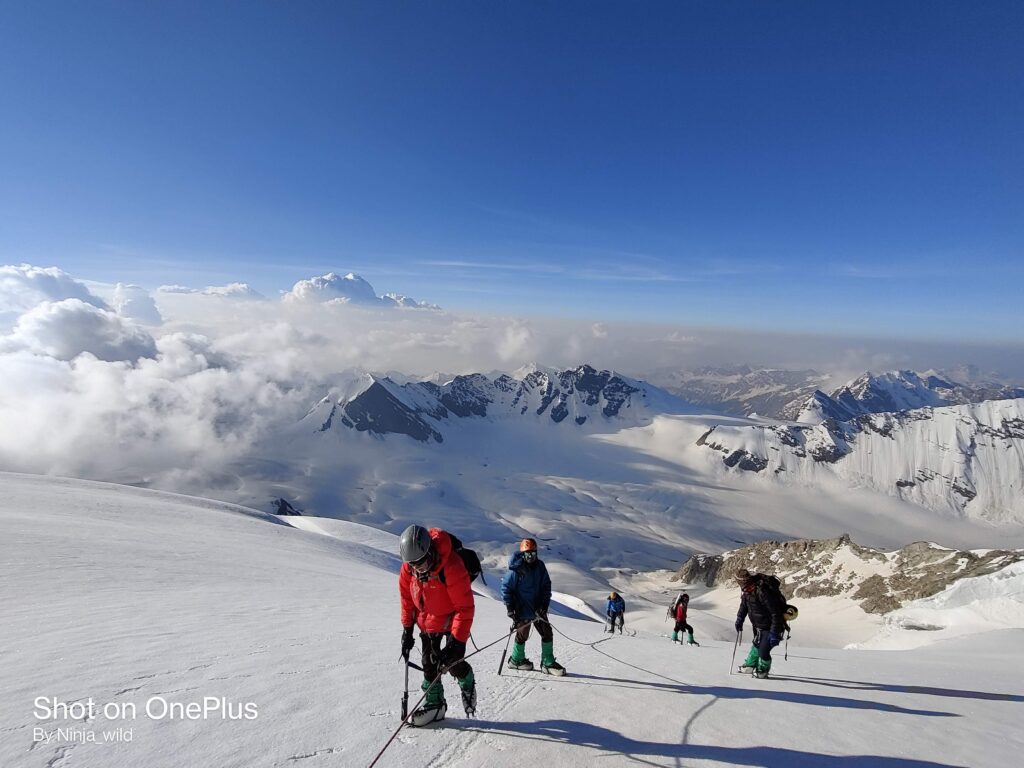
If you’ve been eyeing your first proper mountaineering expedition and wondering whether a 6,000 m peak is realistically within reach, Friendship Peak is very likely the answer. Rising above the Solang Valley near Manali, this peak has earned its reputation as the most accessible introduction to Himalayan mountaineering in India — a place where trekkers take their first real steps into the world of ropes, crampons, and glacier travel. Here’s everything you need to know before you go.
Overview: Why Friendship Peak is the Perfect First Summit
Unlike many Himalayan peaks that demand weeks of remote trekking just to reach base camp, Friendship Peak sits remarkably close to civilization. Its base camp is only a couple of days’ trek from Manali’s Solang Valley, and the entire expedition can be completed in about a week. Despite this accessibility, it still delivers a genuine 6,000 m summit experience — glacier crossings, a real (if moderate) technical summit day, and the unmistakable feeling of standing above the clouds. It’s precisely this combination of achievability and authenticity that makes it the go-to choice for first-time expedition climbers across India.
Friendship Peak Height and Altitude
Friendship Peak stands at 5,289 metres (17,352 feet). While technically just under the traditional 6,000 m mark that many climbers chase, it’s still widely regarded as an entry-level Himalayan “expedition peak” due to its glacier terrain, summit-day technicality, and the mountaineering skills required to climb it safely — making it a fitting warm-up before attempting true 6,000 m giants like Deo Tibba or Yunam Peak.
Location
Friendship Peak is located in the Pir Panjal range, overlooking the Solang Valley, roughly 18 km from Manali in Himachal Pradesh. Its proximity to a well-developed tourist town makes logistics — gear rental, permits, and transport — considerably simpler than for more remote Himalayan peaks.
Route and Itinerary
A typical Friendship Peak expedition follows this general path:
- Manali to Dhundi – A short drive from Manali brings climbers to Dhundi, the road-head near Solang Valley where the trek begins.
- Dhundi to Bakarthach – A day’s trek through pine forest and open meadows leads to Bakarthach, a scenic camping meadow used as an intermediate stop.
- Bakarthach to Base Camp – Climbers continue upward, moving from meadow terrain into more rugged, rocky moraine as they approach base camp beneath the peak.
- Base Camp Acclimatization and Skills Refresher – A rest day is typically used to practice basic climbing techniques — crampon walking, ice-axe arrest, and roped movement — under the guidance of instructors.
- Summit Push – An early morning start (often around 1-2 AM) takes climbers across a glacier and up a moderately steep snow slope to the summit ridge, followed by the return to base camp the same day.
- Descent – The team retraces its steps back down to Dhundi and returns to Manali.
The full expedition typically takes 6 to 8 days, including acclimatization and a buffer day for weather — one of the shortest 6,000 m-class expeditions available in the Indian Himalayas.
Friendship Peak Distance
The total distance covered during the trek and climb is approximately 25 to 30 km round trip, making it considerably shorter than most other Himalayan peak expeditions, and well suited to climbers with limited vacation time.
Best Time to Visit Friendship Peak
The best time to visit Friendship Peak is during two seasonal windows:
- May to June, when winter snow has stabilized into climbable conditions but before the monsoon arrives
- September to October, after the monsoon clears, offering crisp, clear weather and stable snow conditions
The monsoon months of July and August are generally avoided, as the approach trail becomes slippery, and cloud cover significantly reduces visibility on the glacier and summit ridge.
Weather Conditions
Base camp temperatures during the climbing season typically range from 10-18°C during the day, dropping close to freezing at night. On summit day, which usually begins well before sunrise, temperatures can dip several degrees below freezing, especially with wind chill on the exposed upper ridge. While Friendship Peak’s weather is generally more predictable than remoter peaks, sudden shifts — including afternoon cloud build-up — are still common, which is why summit attempts are almost always scheduled for early morning.
Snow and Glacier Conditions
Despite its relatively modest altitude, Friendship Peak features a genuine glacier crossing en route to the summit, along with a moderately steep snow slope near the top that typically requires fixed ropes for safety. Snow conditions can vary considerably from season to season — some years see a straightforward walk-up on firm snow, while others require more careful technical handling due to softer or icier conditions. This variability is part of why the peak, despite being labeled “beginner-friendly,” should never be underestimated.
Fitness Level Required
Friendship Peak demands a moderate fitness level, making it achievable for reasonably active individuals without extensive prior mountaineering background. Useful preparation includes:
- Regular cardiovascular exercise (running, cycling, swimming) for 4-8 weeks before the expedition
- Stair climbing or hill walking with a loaded backpack to build leg strength and simulate trekking conditions
- General core and strength conditioning to handle multi-hour treks and a long summit day
Experience Level Needed
This is one of the few Himalayan expeditions genuinely suitable for complete beginners to mountaineering. Most operators build in a dedicated skills-training day at base camp, teaching the essentials of ice-axe use, crampon walking, and roped travel before the actual summit attempt. That said, “beginner-friendly” doesn’t mean “risk-free” — climbers should still arrive reasonably fit and mentally prepared for a demanding, high-altitude summit day.
Difficulty Rating
Friendship Peak is generally rated easy to moderate difficulty on the spectrum of Himalayan peaks — the most accessible “real” mountaineering objective in this class, though summit day still requires focus, stamina, and proper technique on the glacier and final snow slope.
IMF Permits and Regulations
An IMF (Indian Mountaineering Foundation) permit is required to climb Friendship Peak. Because it lies within a well-established, frequently climbed expedition zone near Manali, permit processing is generally straightforward and quick compared to more remote or restricted peaks. Most trekking and expedition operators handle this paperwork as part of their standard package.
Equipment Checklist
A basic equipment list for Friendship Peak includes:
- Technical gear: Ice axe, crampons, climbing harness, carabiners, helmet (often provided by the operator for this particular peak)
- Clothing: Down jacket, thermal base layers, waterproof outer shell, insulated gloves, balaclava, UV-protection sunglasses/goggles
- Footwear: Insulated mountaineering boots compatible with crampons (rentable in Manali)
- Camping gear: Warm sleeping bag (rated to at least -10°C), sleeping mat, headlamp with spare batteries
- Personal: Trekking poles, sunscreen, lip balm with SPF, water bottles, personal first-aid kit and any altitude sickness medication as advised by a doctor
Since Manali is a well-developed base town, most technical gear can be rented locally, making Friendship Peak one of the more budget- and logistics-friendly expeditions to prepare for.
How Friendship Peak Compares to Other Peaks
Friendship Peak is, without question, the entry point of this peak family. Compared to Deo Tibba (6,001 m) or Yunam Peak (6,111 m), it’s shorter, lower, and considerably less demanding — a natural first step before attempting those slightly higher, more technical climbs. Against Black Peak (6,387 m) or Mt Satopanth (7,075 m), the difference is stark: those expeditions require significantly more experience, fitness, and technical skill, and are generally attempted only after a climber has successfully summited one or more peaks like Friendship Peak first.
Final Thoughts
Friendship Peak has earned its place as India’s most popular introductory Himalayan expedition for good reason — it delivers everything you’d want from your first mountaineering summit (glacier travel, rope work, a genuine high-altitude push) within a short, achievable timeframe close to a well-connected base town. Choose the May-June or September-October window, train for a few weeks beforehand, and go with an IMF-registered operator who provides proper skills training at base camp. For many climbers, standing on Friendship Peak’s summit is the first step toward a lifelong passion for the mountains.